

Winterfront vs. Bugscreen: When to Switch (and at What Temperature)
Every October, the same thing happens on Highway 16. Half the trucks still have bugscreens on their grilles in a snowstorm. Come May, the other half are still running winterfronts in +15 °C sunshine.
Both halves are costing themselves money.
A bugscreen and a winterfront look similar from twenty feet away — two covers, same grille, same clips. But they do opposite jobs, and running the wrong one at the wrong time doesn't just fail to help. It actively works against your engine.
Here's how to know which one belongs on your truck right now.
They Solve Two Completely Different Problems

A bugscreen is a filter. Air still moves through it — that's the whole point. What doesn't move through is everything else: bugs, gravel, road debris, and the caked-on mess that plugs your radiator fins and chokes off cooling in the middle of July. Your engine still breathes; it just breathes clean.
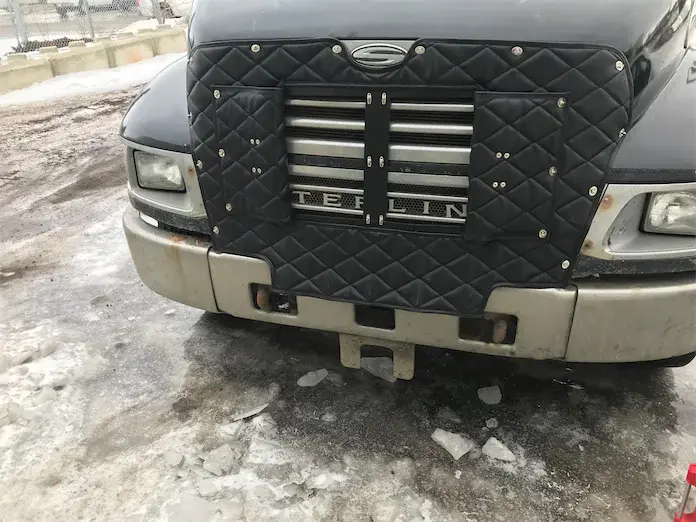
A winterfront is a regulator. It reduces how much frozen air blasts through your grille so your engine can hold operating temperature instead of fighting to make heat. In an Alberta January, that's the difference between an engine at proper temperature and one running cold, diluting its own oil, and burning extra fuel to stay warm.
One keeps things out. One keeps heat in. They're not seasonal versions of the same product — they're two different tools.
The Calendar Isn't Your Trigger. The Thermometer Is.
Drivers tend to switch by habit — Thanksgiving, first snow, May long weekend. But Alberta's shoulder seasons don't follow the calendar, and the numbers show exactly why that's a problem.
In Edmonton, frost typically returns around September 22, and the last spring frost lands around May 8. That's roughly 180 days a year where the overnight low touches freezing or colder, and about 83 days where the temperature never climbs above 0 °C at all. We drop below −20 °C on around 25 days in a typical year.

But here's the part most people miss: only three or four nights a year get into the minus-thirties.
That spread matters enormously, because — as you're about to see — your engine manufacturer cares a lot about the difference between −5 °C and −35 °C.
Parked Overnight? Close Them Up
Here's the part that confuses people, and it's worth clearing up before anything else.
Our winterfronts aren't airtight, and they were never meant to be. Quilted vinyl breathes. The fit follows your grille, but it isn't a hermetic seal. So "doors closed" doesn't mean your engine is suffocating behind a sheet of plastic — it means airflow is reduced, which is the entire job.
That's why closed is the normal winter position. When it's genuinely cold out, that's how the winterfront earns its money — holding the heat your engine works to make instead of letting a −30 °C headwind strip it away.
Now the other half — and this is the part drivers get backwards.
Everything above is about a working engine. Airflow rules exist because a charge air cooler under load has heat to shed. Park the truck and shut it down and that requirement goes away with it. There's no charge air to cool, no fan to run, no aftertreatment to confuse. Nothing needs to breathe.

So when you shut down for the night in deep cold, close the doors. Your engine spent all day building heat, and a closed winterfront slows how fast that heat bleeds out into a −30 °C parking lot. You come back to an engine that's warmer than it had any right to be — easier on the starter, easier on the batteries, and less time sitting there in the morning waiting for temperature before you can pull out.
There's a second case straight out of Detroit's manual: if you're idling in extreme cold, a winterfront is explicitly listed as a legitimate way to improve heater performance in the cab. Less cold air blowing through the engine bay means the coolant your bunk heater draws from stays hotter.
This is exactly why our winterfronts are built with doors. Closed overnight and while idling, so you hold every degree you've got. Opened up when you fire up and roll out, so the engine breathes the way it was designed to. Same cover, two completely different jobs, and you decide which one it's doing.
The Practical Switching Guide for Alberta
Everything above this point comes straight out of the engine manufacturers' own documentation. What follows is our shop guidance — forty years of watching what actually works on Alberta trucks. Your manual always wins if it says otherwise.
Conditions | What goes on the grille |
Consistently above 0 °C | Bugscreen. Bug season, gravel season, construction season. |
Around 0 °C, shoulder season | Winterfront, doors open. Cover's on, airflow's unrestricted. |
Cold winter driving | Winterfront, doors closed. Crack them if temps or fuel burn climb. |
Deep cold (−30 °C and below) | Winterfront, doors closed. This is what it's built for. |
Parked overnight or idling | Winterfront, doors closed. Hold the heat in. |
Two extra judgment calls worth making:
Swapping the bug screen for a winterfront isn't a downgrade in protection. A bug screen earns its keep year-round — it stops rocks and road debris, not just bugs. But both covers occupy the same grille, and once winter sets in, managing engine temperature is the bigger problem. That's the trade you're making, and in an Alberta winter it's the right one.
Sleeper time changes the math. A driver who parks indoors every night and one who sleeps in the bunk at −28 °C are running two different trucks, as far as the winterfront is concerned. If you're spending nights out in it, you'll be working those doors a lot more than someone who plugs in at a heated yard.

Built for −55 °C, Because That's Where We Live
Factory-supplied winterfronts are usually thin, low-grade, and built for climates a lot gentler than ours. They'll hold up at −5 °C. At −20 °C, they stop doing the job.
We build ours from high-quality quilted vinyl padded with foam, rated to withstand temperatures as low as −55 °C — and with the door design that lets you run them properly through the shoulder season instead of guessing.
We've got patterns for Peterbilt, Kenworth, Mack, Freightliner, Western Star, and more, with the most popular fits in stock — often same-day. No factory clips? Not a problem. No pattern for your truck? Come by the shop and we'll make one off your grille.
Made in Edmonton, shipped Canada-wide, and built by people who've spent forty years finding out what actually survives an Alberta winter.
Call us at (780) 486-1061 for a free quote, or get in touch here.


Comments